
Dalby Forest is somewhere you can make a whole family day of a relatively short bike ride. That was a big part of the appeal for us: time in the woods, somewhere to stop for food and a play park the children were genuinely excited about afterwards.
This review is based on two summer visits, when our daughter was five and our little boy was one. On our first visit we rode Ellerburn beside the beck. We also tried the green-graded Adderstone trail, with our daughter cycling independently and our son in a bike seat.
We enjoyed both, but they are quite different days out. Ellerburn is the one I’d look at first for younger or less experienced riders. Adderstone needs more thought about distance, even though it carries a green grade.
On this page
- Choose your ride before choosing your car park
- Ellerburn: our first visit
- Adderstone: green does not mean short
- Is Dalby traffic-free?
- What about the cycle skills area?
- The playgrounds and a sensible family plan
- Café, toilets and access needs
- How much does it cost to park?
- What if the weather turns?
- Would we recommend Dalby for family cycling?
- Cycle enjoyment rating
Choose your ride before choosing your car park
| Ride | Published distance | Starting area | Our take for families |
|---|---|---|---|
| Ellerburn short route | 2.8km / 1.7 miles | Low Dalby, by the Visitor Centre and Courtyard | The more manageable starting point for developing riders |
| Ellerburn long route | 4.5km / 2.8 miles | Low Dalby | More riding without committing to a long forest outing |
| Adderstone short loop | 12.9km / 8 miles | Dixon’s Hollow, beside Adderstone Field | For children already comfortable with a longer ride |
| Adderstone long loop | 19.3km / 12 miles | Dixon’s Hollow | A substantial step up in distance, not just a small extension |
Distances come from Forestry England’s Ellerburn and Adderstone pages. The shorter Ellerburn figure is 2.8 kilometres, while its longer route is 2.8 miles. It is an easy pair of numbers to muddle.
Dalby is big enough that “we’ll park and work it out” can add unnecessary faff. Look at the forest overview map first and decide which starting area suits your day.
Ellerburn: our first visit
We took Ellerburn on our first trip. Riding alongside the beck gave us plenty to look at, and it felt like a proper outing through the woods without needing to spend the whole day pedalling.
The route starts around Dalby Courtyard near the Visitor Centre. Follow the purple markers with white arrows. Forestry England describes it as a shared forest-track route, mostly flat with a steady incline towards the end, rather than completely level throughout.
The shared use matters. Children will meet walkers, dogs and people using wheelchairs or pushchairs. Give everyone space, slow down when passing and keep younger children close beside the water.
For a child learning to ride, I’d begin with the shorter option and see how they are getting on. Finishing with enthusiasm left for the playground is better than extending the ride just because another loop is available. For a balance-bike rider, even the short loop may be more than they want: there is nothing wrong with making a smaller outing and returning before they are tired.
One of the practical benefits for us was being near the main visitor area again afterwards. The play park provided a very useful incentive, and the children loved it.
Adderstone: green does not mean short
We chose Adderstone because its green grading seemed the sensible level with a young child riding independently and a baby on the back of my bike. Our daughter found the riding relatively straightforward, but we still needed several snack and water stops.
Our original visit notes don’t distinguish which Adderstone variant we completed, so I won’t pretend we tested both loops. What I do remember is that having an achievable riding surface did not remove the need for breaks.
Start at Dixon’s Hollow car park beside Adderstone Field. The short loop is still eight miles. That is a very different commitment from Ellerburn, particularly if your child’s normal rides are a few laps of a park.
Before setting off, be clear about the short-loop junction and where the longer route goes. A useful point raised in Tripadvisor visitor feedback is that some riders found the signs and long/short route choices confusing. Forestry England replied that signage improvements were underway. I’d pick up the current cycling map and ask about your chosen branch rather than relying on spotting every marker as you go. Maps are available to buy at the Visitor Centre.
Keep snacks and water with you, not in the car. On a longer forest loop, the moment a child needs something is unlikely to coincide neatly with arriving back at the café.
Is Dalby traffic-free?
Not everywhere. There is plenty of riding away from ordinary roads, but it would be misleading to describe the entire forest as traffic-free once you have parked.
Forestry England specifically mentions a road section near Givendale Head in its Adderstone description. Its forest map also warns that Dalby is a working forest, with vehicles, timber lorries and machinery. Car parks and access roads need the same attention as they would anywhere else.
Follow the route signs and any closures, regroup before crossings and don’t let children assume that every track is a vehicle-free cycle path. We felt relaxed riding here, but that is different from saying there are no hazards or that children can roam without supervision.

What about the cycle skills area?
There is a separate skills area near Low Dalby, reached along Ellerburn. The operator describes technical loops ranging from green to red.
That makes it a place to choose a suitable section, not an all-ages playground where every feature is appropriate for beginners. Have a look first, read the grading and leave anything beyond the rider’s ability. There is no need to progress to a harder feature just because other children are riding it.
Our family experience in this review is Ellerburn and Adderstone, not a test of Dalby’s harder mountain-bike trails. Those are a different proposition from the rides we chose with a bike seat.
The playgrounds and a sensible family plan
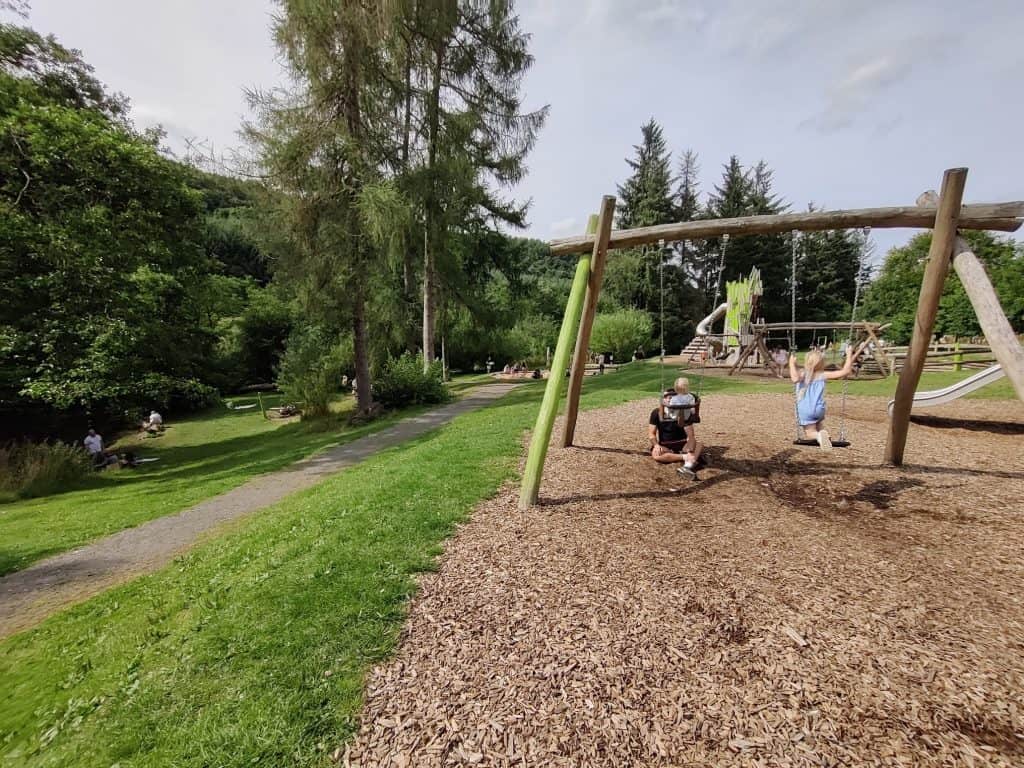
The children’s enjoyment of the play park was one of the lasting memories from our visits. The natural setting suited the rest of the day, and summer in the forest had a lovely atmosphere with families enjoying being outside.
For a first visit, I’d keep the plan simple:
- Start at Low Dalby and sort out toilets, map and snacks.
- Ride the shorter Ellerburn option, or less if that suits your child.
- Have lunch and spend some time at the playground rather than adding mileage automatically.
The Grandfather Oak play area is beside the Visitor Centre. Forestry England now reports an upgraded toddler zone, including wider bridges and sensory features. That is a current facility update, not something we are claiming to have tried on our earlier visits.
For families choosing Adderstone, the field provides space for a picnic and games around that end of the forest. Don’t assume the main Visitor Centre café and Grandfather Oak playground are immediately beside your parked car at Dixon’s Hollow. They belong to a different starting area.




Café, toilets and access needs
The Visitor Centre is a useful place for trail advice and a café stop, with indoor and outdoor seating. Check the current hours before relying on a late meal or drink.
Dalby lists toilets, accessible toilets, baby-changing facilities and a Changing Places facility. Check their locations against your chosen start rather than assuming every smaller car park has the same facilities.
For adaptive cycling, contact Dalby Forest Cycle Hub before travelling. It offers adapted cycles and support, but also warns that gradients on the routes it promotes may be unsuitable for some manual wheelchair users. An easy-access label is not a guarantee for every person or piece of equipment.
Separately, Forestry England offers free all-terrain mobility-vehicle hire through the Visitor Centre. Call 01751 460295 to discuss availability and an appropriate route. We haven’t tested the hire equipment ourselves.
How much does it cost to park?
The old seasonal £10/£5 prices from our earlier review have been replaced. The current Forestry England parking panel, checked in November 2026, lists:
| Length of stay | Car parking |
|---|---|
| Up to 1 hour | £3.50 |
| Up to 2 hours | £6.50 |
| Up to 3 hours | £9.50 |
| Up to 4 hours | £12.50 |
| Over 4 hours | £15 |
It is an ANPR pay-on-exit system and card payments are accepted. Check the signs on arrival, especially if you are moving between starting areas or allowing time for lunch and play as well as riding.
Bringing our own bikes and food helps keep the rest of the day straightforward. Hire, maps, food and optional activities such as Go Ape are separate costs, so “everything is free apart from parking” would be too broad.
For me, the parking makes more sense when you are staying for a proper day out than for a very short ride. I wouldn’t extend a tired child’s outing just to feel we had got our money’s worth, though.
What if the weather turns?
Both visits behind this review were in summer, so these aren’t firsthand winter trail reports. Check the live forest notices and conditions before travelling. Wet leaves, muddy patches or poor visibility can change how manageable a route feels.
If the weather is unsettled, I’d favour a shorter outing near Low Dalby over committing to the longer Adderstone loop. Take an extra layer and be prepared to leave the bikes on the car if the conditions aren’t right. The café can offer a break, but Dalby is primarily an outdoor day, not an indoor wet-weather attraction.
Would we recommend Dalby for family cycling?
Yes. Our two visits gave us the combination we enjoy: riding together, being in the woods and enough to do afterwards that the whole day didn’t revolve around how far we had cycled.
For a beginner, my first choice would be Ellerburn and time at Grandfather Oak. For a child who already enjoys longer rides, Adderstone gives you more forest to explore, provided you plan for its distance and road section.
Choose the ride for the child you have with you that day, not simply the colour on the sign. That is the main difference between a day everyone enjoys and one that becomes hard work long before you get back to the car.
Cycle enjoyment rating
Last Updated on November 20, 2026 by Ryan

Hello. I am Ryan and along with my wife Beth and our two children Matilda and Barney, we love all things cycling and exploring. We spend our weekends exploring fun places to cycle and discover and wanted to help other people do the same too. There’s no better way to travel than via bike and it’s an amazing activity for the whole family to enjoy.